Modern livestock production is undergoing a significant transformation. With increasing pressure to reduce antibiotic growth promoters, improve feed efficiency, and enhance animal welfare, nutritionists are turning toward functional feed additives that are backed by science. Among the most researched and widely adopted solutions are yeast and yeast extracts in animal feed.
Derived primarily from Saccharomyces cerevisiae, yeast-based ingredients are supported by decades of peer-reviewed research across poultry, swine, dairy, and beef production systems. Clinical trials have demonstrated improvements in gut health, immune response, rumen stability, and growth performance.
This article presents a structured, evidence-based overview of yeast and yeast derivatives in feed, drawing on published clinical studies and explaining how feed manufacturers and farmers can strategically incorporate them into formulations for measurable results.
What Are Yeast and Yeast Extracts in Animal Feed?
Yeast ingredients used in livestock nutrition fall into four primary categories.
Yeast Ingredient Type
Description and Primary Function
Live Yeast (Active Dry Yeast)
Contains viable yeast cells that influence microbial balance in the digestive tract and rumen.
Yeast Culture
Includes yeast cells plus fermentation metabolites produced during controlled fermentation.
Yeast Extract
Obtained from the internal contents of yeast cells. Rich in peptides, amino acids, nucleotides, and growth factors that support immunity and palatability.
Yeast Cell Wall Components
Contain beta-glucans and mannan-oligosaccharides (MOS), known for immune modulation and pathogen binding.
Each form functions differently in animal physiology, but all aim to optimize digestive health and nutrient utilization.
Explore the full range of animal nutrition ingredients from Titan Biotech Ltd, including beta-glucans and MOS-based additives for livestock formulations.
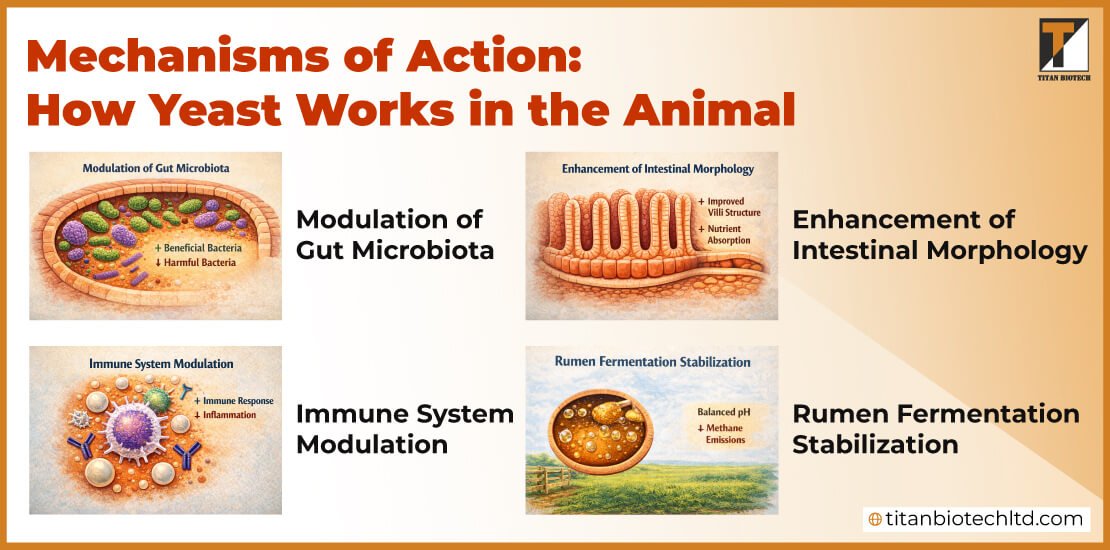
Mechanisms of Action: How Yeast Works in the Animal
Mechanisms of Action: How Yeast Works in the Animal
Clinical research has identified several key mechanisms through which yeast exerts its benefits.
Modulation of Gut Microbiota:A 2020 review published in the Journal of Applied Microbiology concluded that supplementation with S. cerevisiae improves microbial balance by encouraging beneficial bacteria and limiting pathogenic colonization. Competitive exclusion reduces harmful bacterial attachment in the intestine.
Modulation of Gut Microbiota:A 2020 review published in the Journal of Applied Microbiology concluded that supplementation with S. cerevisiae improves microbial balance by encouraging beneficial bacteria and limiting pathogenic colonization. Competitive exclusion reduces harmful bacterial attachment in the intestine.
Enhancement of Intestinal Morphology:A 2022 study in the journal Animals evaluated yeast derivatives in broilers and reported significant improvements in villus height and villus-to-crypt ratio. Improved gut morphology directly enhances nutrient absorption efficiency.
Immune System Modulation:Research published in Journal of Animal Science and Biotechnology (2016) demonstrated that yeast beta-glucans modulate inflammatory responses in piglets exposed to lipopolysaccharide (LPS) challenge. The study showed reduced inflammatory cytokine expression, indicating improved immune regulation.
Rumen Fermentation Stabilization:A 2025 study in Translational Animal Science found that yeast culture supplementation improved rumen fermentation efficiency and nutrient digestibility in beef heifers. Yeast stabilizes rumen pH and enhances volatile fatty acid production.
Clinical Evidence by Animal Species
Poultry: Growth, Gut Health and Immunity
Poultry production demands optimal feed conversion ratio (FCR) and strong immune resilience.
Poultry Science (2019): Broilers supplemented with yeast-derived carbohydrates showed improved feed conversion ratio and increased serum IgA levels under immune challenge conditions.
Animals (2022): Yeast derivatives improved intestinal barrier integrity and villus height in broiler chickens.
Journal of Applied Microbiology (2020): Documented competitive exclusion effects of S. cerevisiae in non-ruminants, supporting pathogen reduction.
Swine: Weaning Support and Gut Stability
Weaning stress significantly impacts piglet growth and gut health.
Journal of Animal Science and Biotechnology (2016): Yeast cell wall supplementation reduced inflammatory responses and improved intestinal morphology in LPS-challenged piglets.
Animals (2022): Piglets receiving yeast extract showed improved average daily gain and improved intestinal barrier markers.
Ruminants: Fermentation Efficiency and Milk Performance
Ruminant nutrition differs from monogastrics due to the rumen microbial ecosystem.
Translational Animal Science (2025): Yeast culture improved nutrient digestibility and fermentation efficiency in beef heifers.
Buffalo calves research (2023): Reported improved rumen morphology and enhanced short-chain fatty acid production with yeast supplementation.
Advantages of Yeast Extract Across Animal Species
Poultry (Broilers and Layers)
How Yeast Helps Chickens?
Better feed conversion: Birds gain more body weight from the same amount of feed.
Improved gut health: The inner lining of the intestine becomes stronger and healthier, helping birds absorb nutrients better.
Stronger immunity: Birds show better resistance against common infections.
Lower risk of harmful bacteria: Yeast helps reduce the growth of harmful bacteria in the gut.
Better performance during heat stress: Birds cope better with hot weather and stressful conditions.
Yeast helps chickens grow better, stay healthier, and use feed more efficiently.
Swine (Piglets and Growing Pigs)
How Yeast Helps Pigs?
Reduced weaning stress: Piglets adjust more easily when shifting from milk to solid feed.
Improved gut development: The intestine becomes stronger and more stable.
Less diarrhea: Better balance of good bacteria reduces digestive upsets.
Better growth rate: Piglets gain weight more steadily.
Improved feed intake: Pigs eat more consistently after weaning.
Yeast helps piglets stay strong after weaning and grow with fewer stomach problems.
Dairy Cattle
How Yeast Helps Dairy Cows?
Improved rumen function: Supports healthy fermentation inside the rumen.
Better feed digestion: Cows get more nutrients from the same feed.
Improved milk production: Milk yield becomes more consistent.
Stable rumen pH: Helps reduce the risk of acidosis when feeding high-energy diets.
Better feed intake: Cows tend to eat more steadily.
Across species, yeast and yeast derivatives help with:
Better digestion
Enhanced utilization of feed nutrients
Stronger immunity
Better growth performance
Support for antibiotic-free feeding programs
Economic Impact of Yeast Supplementation
From a farm profitability perspective, yeast contributes through improved feed conversion ratio, reduced mortality, lower veterinary costs, enhanced nutrient utilization, improved carcass yield, and stable milk production.
Key Economic Insight: Even a small improvement in FCR (2 to 3%) can translate into significant financial gains in commercial operations. For large-scale producers, this margin improvement compounds across every production cycle.
Application Strategy in Feed Formulations
Incorporating yeast into feed formulations requires careful consideration of species, production stage, stress level, health challenges, and environmental conditions.
Animal Category
Recommended Application Stage
Broilers
Starter feeds
Piglets
Weaning diets
Dairy Cows
Lactation rations
Beef Cattle
Finishing diets
Consistency in quality, viable cell counts (for live yeast), and standardized beta-glucan levels are critical to achieving consistent results.
Why Ingredient Quality Matters?
Clinical study outcomes depend on yeast strain selection, fermentation quality control, processing stability, active compound concentration, and shelf-life integrity.
Feed manufacturers must source yeast from reliable producers who maintain standardized fermentation and drying protocols to ensure reproducible performance in commercial settings.
Titan Biotech Ltd maintains strict quality standards across all yeast-based products.
Source Premium Yeast Ingredients for Animal Feed
Titan Biotech Ltd supplies high-quality, standardized yeast and yeast extract products for poultry, swine, dairy and ruminant feed manufacturers worldwide. Connect with our team for product specifications, samples and bulk pricing.
Conclusion
Clinical research consistently demonstrates that yeast and yeast extracts are effective functional feed ingredients. Across poultry, swine, and ruminant systems, studies show improvements in gut morphology, immune modulation, fermentation efficiency, and growth performance.
As the animal nutrition industry continues to move toward antibiotic-free, sustainable production models, yeast-based ingredients provide a science-backed solution for improving feed efficiency and animal health.
For feed manufacturers and livestock producers seeking evidence-based performance enhancers, yeast and yeast extracts represent a reliable, clinically supported addition to modern feed formulations.
FAQs About Yeast and Yeast Extracts in Animal Feed
Is yeast safe for all livestock species?
Yes. Saccharomyces cerevisiae has a long history of safe use across poultry, swine, ruminants, and other livestock species.
Can yeast replace antibiotic growth promoters in animal feed?
Clinical studies suggest yeast can support gut health and immune resilience, making it a valuable component of antibiotic-free feeding programs.
How quickly does yeast show performance results in livestock?
Improvements in gut health markers can appear within 2 to 4 weeks, depending on species and farm conditions.
What is the difference between live yeast and yeast extract?
Live yeast supports fermentation and microbial balance, particularly in ruminants. Yeast extract primarily provides immune and palatability benefits through peptides, nucleotides and amino acids.
Does yeast improve feed intake in young animals?
Yeast extracts contain nucleotides and amino acids that enhance feed palatability, especially in young animals. This is particularly useful during weaning transitions in piglets and early starter phases in broilers.
Does yeast help during heat stress in poultry?
Research in poultry shows improved intestinal integrity and immune stability during stress conditions when yeast-based additives are included in the diet.
What is the role of beta-glucans in animal feed?
Beta-glucans derived from yeast cell walls are known for modulating the immune system, reducing inflammatory responses and improving resistance to disease. They are particularly well studied in poultry and swine nutrition.
What is MOS and how does it benefit livestock?
Mannan-oligosaccharides (MOS) are yeast cell wall components that bind to pathogenic bacteria in the gut, preventing them from attaching to the intestinal wall. This supports a cleaner, more balanced gut environment across species.
Can yeast be used in dairy cow diets without affecting milk composition?
Yes. Research supports that yeast culture supplementation improves rumen stability and nutrient digestibility without negatively affecting milk composition. In many cases, milk yield consistency improves alongside better rumen function.
What makes yeast extract beneficial for companion animals like dogs?
Yeast extract improves feed palatability, supports immune function and provides nutrients that contribute to healthy skin and coat condition in companion animals.
How should yeast be included in starter feed for broilers?
Yeast is typically included during the starter phase when the gut is still developing. Early inclusion supports villus development, microbial balance and immune priming, laying a foundation for better performance through the grow-out period.
Where can I source high-quality yeast extract for animal feed?
Titan Biotech Ltd manufactures and supplies standardized yeast and yeast extract products for livestock and companion animal nutrition. Visit www.titanbiotechltd.com or contact our team for product details and bulk supply options.
About Titan Biotech Ltd
Titan Biotech Ltd stands among the trusted names in biotechnology manufacturing, with a strong presence across global markets. The company specializes in producing yeast-derived ingredients, fermentation-based compounds, and performance-focused feed additives tailored for the animal nutrition, food processing, and pharmaceutical sectors. With decades of experience in yeast fermentation technology, Titan Biotech Ltd serves feed manufacturers, integrators and livestock producers across multiple regions with consistent, high-quality ingredient solutions.
Our animal nutrition portfolio includes active dry yeast, yeast culture, yeast extract, yeast cell wall fractions, beta-glucans and mannan-oligosaccharides. Each product is manufactured under stringent quality protocols including strain-specific fermentation, controlled drying, and multi-parameter batch testing to ensure reliable performance in the field.
Titan Biotech Ltd is committed to advancing sustainable, antibiotic-free animal production through science-backed ingredient solutions. Our technical team partners with nutritionists and feed formulators to deliver products that meet the evolving demands of modern livestock and companion animal nutrition.
For product inquiries, technical support, certifications or bulk supply discussions, visit www.titanbiotechltd.com or reach out through our contact page.